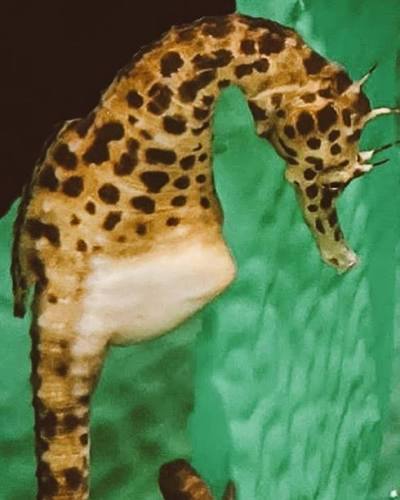
The giraffe seahorse (Hippocampus camelopardalis) is a rare and unique species of marine fish belonging to the family Syngnathidae, which includes all seahorses, pipefishes, and seadragons. Its scientific name, camelopardalis, translates directly to “giraffe,” inspired by the distinct, crown-like physical features and markings that resemble the African land mammal. [1, 2, 3]
Key Characteristics & Habitat
- Distribution: They are native to the Western Indian Ocean, specifically along the south and east coasts of Africa, spanning from South Africa, Mozambique, and Tanzania, and possibly as far north as Kenya. [1, 2, 3]
- Habitat: These seahorses primarily dwell in estuarine seagrass beds, algal beds, and shallow coral reefs. They typically inhabit waters ranging from shallow depths down to 45–60 metres. [1, 2]
- Size: They are relatively small, growing to a maximum length of roughly 10 centimetres (3.9 inches). They reach sexual maturity at about 6.5 centimetres. [1]
- Diet & Behavior: Like most of their relatives, they are expected to feed mainly on tiny crustaceans. They are ovoviviparous, meaning the males carry the eggs in a specialized brood pouch located under their tail until they give birth to live young. [1, 2]
Conservation Concerns
The giraffe seahorse is currently categorized as Data Deficient on the IUCN Red List of Threatened Species. Because they are so elusive and rarely kept successfully in captivity, marine scientists still know very little about their exact population numbers. [1, 2]
However, they face substantial threats from habitat loss, coastal pollution, and overexploitation. In regions like Mozambique and Tanzania, they are frequently caught as accidental bycatch in fine-mesh mosquito fishing nets or deliberately harvested to be dried and sold for traditional medicine and the curio trade. Conservation groups like Project Seahorse work alongside grassroots organizations to research and protect their fragile seagrass ecosystems. [1, 2, 3]
Would you like to explore similar unique seahorse species, learn about their camouflage mechanisms, or see how organizations track them through community science programs like iSeahorse?