
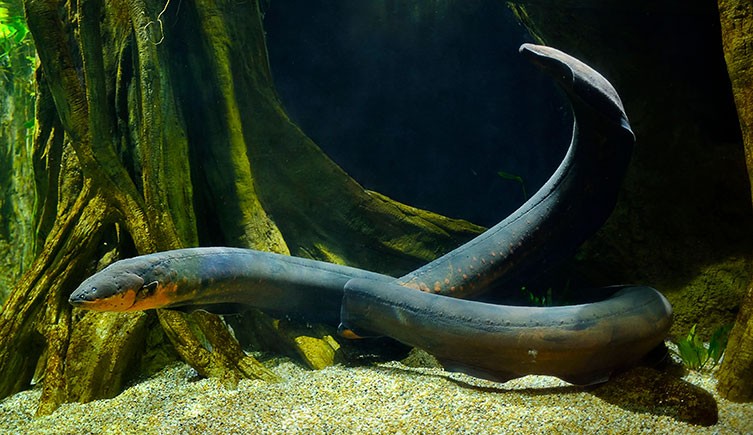
Despite their name and snake-like appearance, electric eels (Electrophorus) are not true eels at all. They are actually a genus of neotropical freshwater knifefish more closely related to catfish and carp. Native to the dark, murky waters of the Amazon and Orinoco river basins in South America, these remarkable fish are famous for their ability to generate massive bioelectric shocks to hunt, defend themselves, and navigate. [1, 2, 3, 4, 5]
Historically treated as a single species (Electrophorus electricus), DNA sequencing revealed that there are actually three distinct species: E. electricus, E. varii, and E. voltai. Among them, Electrophorus voltai can deliver a staggering 860-volt shock—the strongest electrical discharge of any known animal on Earth. [1, 2, 3]
⚡ How Do They Produce Electricity?
An electric eel’s body functions like a living, organic battery. Roughly 80% of its body is dedicated to three specialized electric organs: the Main organ, Hunter’s organ, and Sachs’ organ. [1, 2]
- The Living Batteries: These organs are packed with hundreds of thousands of modified muscle cells called electrocytes. Each electrocyte holds a small charge. When the eel spots prey or feels threatened, its brain sends a sudden signal through the nervous system. This causes all the electrocytes to discharge simultaneously, combining their tiny voltages into one massive current. [1, 2]
- High vs. Low Voltage: The Main and Hunter’s organs handle high-voltage discharges used for offense and defense. Sachs’ organ generates low-voltage pulses (around 10 volts). Because electric eels have poor eyesight and live in muddy waters, they use Sachs’ organ like underwater radar (electrolocation) to sense their surroundings and track movements. [1, 2, 3]
🐟 Behavior, Hunting, and Diet
- The “Doublet” Trick: When hunting in dark waters, an eel will emit two quick, high-voltage pulses called a “doublet”. This shock bypasses the prey’s regular defenses and forces its muscles to twitch involuntarily. The resulting ripple in the water alerts the eel exactly where the hiding fish is. The eel then unleashes a barrage of high-voltage pulses that completely paralyzes the prey in milliseconds. [1, 2]
- Supercharged Shocks: To maximize the shock on large or difficult prey, an eel will curl its body to bring its positive head and negative tail closer together, overlapping and doubling the electric field intensity. They have also been documented leaping out of the water to press their chins directly against predators, bypassing the dampening effect of the water to deliver the full brunt of their electricity. [1]
- Diet: They are generalist carnivores. Adults primary eat other fish, crustaceans, amphibians, and small mammals, while juveniles eat invertebrates. [1]
- Social Swarms: While once thought to be completely solitary hunters, researchers have observed electric eels hunting cooperatively in packs (called swarms) to herd and seamlessly ambush schools of fish. [1, 2]
📏 Physical Characteristics
Electric eels can grow to exceptional sizes, often reaching 6 to 8 feet (2 to 2.5 metres) in length and weighing up to 44 pounds (22 kg). Their cylindrical bodies are covered in thick, scaleless skin that acts as a protective insulator, shielding them from electrocuting themselves. Because they live in oxygen-depleted waters, they are actually obligate air-breathers—they must rise to the surface every 10 minutes or so to gulp air, taking in about 80% of their oxygen through their highly vascularized mouths. [1, 2, 3, 4]