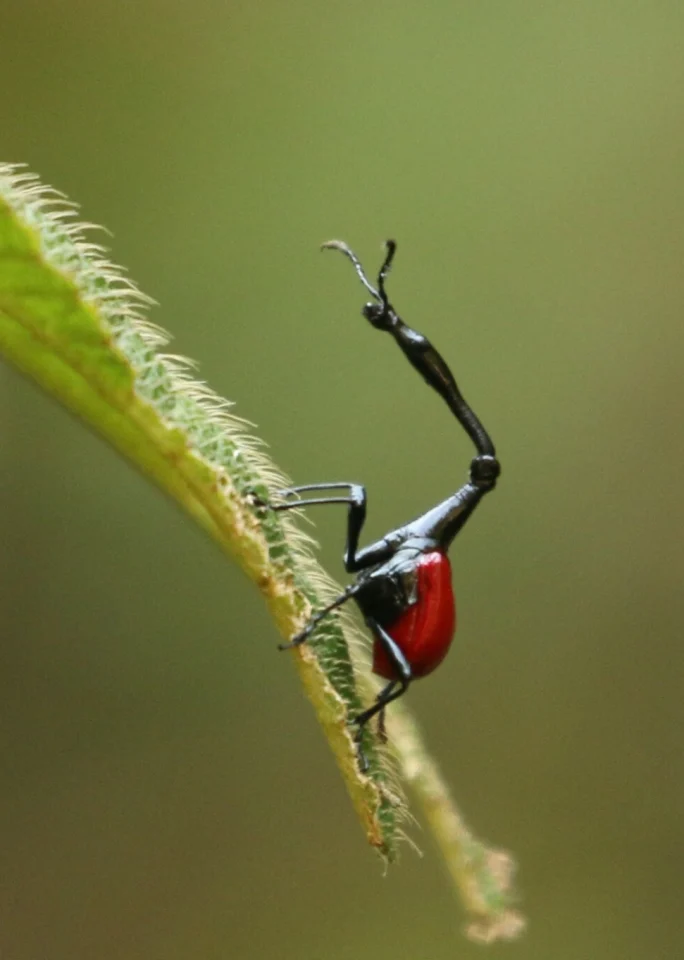
The giraffe-necked weevil (Trachelophorus giraffa) is a striking, sexually dimorphic beetle endemic to the rainforests of Madagascar. It is instantly recognisable by its bright red wing covers (elytra) contrasting against a glossy black body, and an extraordinarily elongated jointed prothorax that functions like a neck. [1, 2, 3]
Key Characteristics & Anatomy
- Sexual Dimorphism: The species exhibits extreme differences between sexes. The male’s “neck” is typically two to three times longer than the female’s. [1, 2]
- Size: They generally measure up to 1 to 2 inches (25–50 mm) in total body length. [1, 2]
- True Identity: Despite their common name, they belong to the leaf-rolling beetle family (Attelabidae), making them distinct from true weevils. [1]
- Defense Mechanism: They are completely harmless to humans and lack a bite or sting. However, if they feel threatened, they can deploy transparent wings to fly away or execute an impressive leap up to 100 times their body length. [1, 2, 3, 4]
Unique Behaviour and Reproduction
The giraffe-necked weevil’s entire life cycle is intimately tied to specific native host trees, primarily Dichaetanthera arborea and Dichaetanthera cordifolia. [1]
- Male Jousting: During the mating season, males use their crane-like necks as weapons to wrestle, swipe, and shove rival males off leaves to secure mating rights with a female.
- Intricate Nest Building: The female’s shorter neck serves as a powerful mechanical lever. After mating, she uses her legs and neck to meticulously roll a single leaf from the host tree into a tight, cigar-like tube.
- The Egg Cradle: She lays a single egg inside this rolled leaf before snipping the bundle so it drops to the forest floor. When the tiny yellowish larva hatches, the walls of the rolled leaf serve as its safe nursery and its very first meal. [1, 2, 3, 4, 5, 6]
For a complete breakdown of their taxonomy and conservation context, you can read more on the Wikipedia Giraffe Weevil Page or view field observations logged on iNaturalist.