
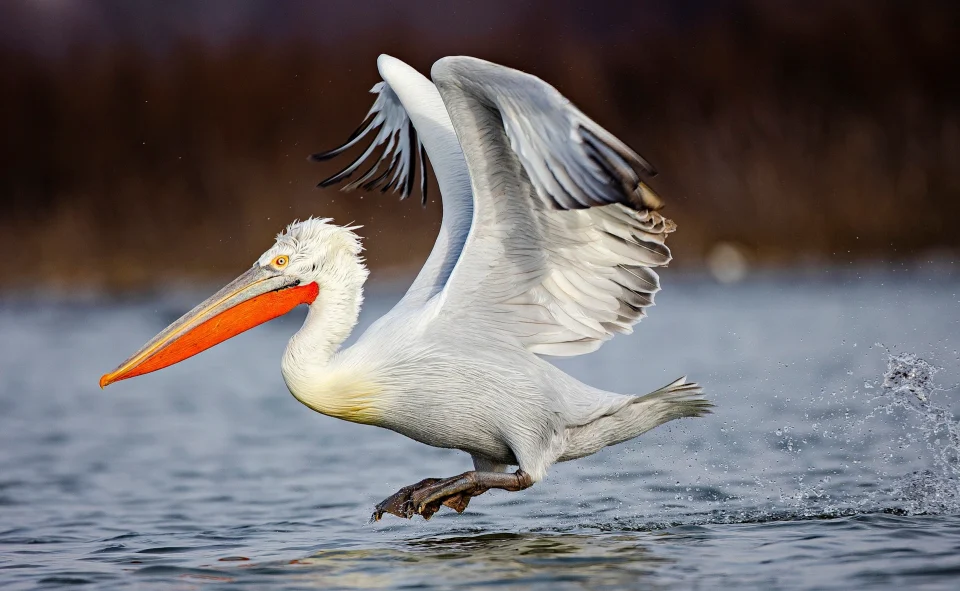
The Dalmatian pelican (Pelecanus crispus) is the largest pelican species in the world and ranks among the heaviest flying birds alive. Easily identifiable by its massive bill and “shaggy” appearance, it is a magnificent soaring waterbird native to the lakes and wetlands of Eurasia. [1, 2, 3]
Physical Profile
- Size & Weight: They typically weigh between 10 to 15 kg (22 to 33 lbs) and feature an impressive wingspan stretching 2.7 to 3.5 metres (8.8 to 11.5 feet). [1, 2, 3]
- Distinctive Features: They are known for a diagnostic curly crest of feathers on the nape of their neck. They possess a pale grey iris and an enormous bill measuring 37 to 45 cm long. [1, 2]
- Breeding Colours: While their overall plumage is a silvery, dirty white, their expandable gular (throat) pouch turns a striking bright orange-red during the breeding season. [1, 2, 3]
Habitat & Diet
These giant birds thrive primarily in freshwater wetlands, shallow lakes, marshes, and river deltas. They feed almost exclusively on fish. Dalmatian pelicans are famous for their cooperative surface fishing, where a group will gather to encircle schools of fish in shallow water and drive them toward the shore to be easily scooped up in their 12-litre throat pouches. [1, 2, 3, 4]
Distribution & Conservation
- Range: Their breeding range stretches across southeastern Europe (such as Greece’s Lake Kerkini and the Danube Delta) into central Asia and Russia. They migrate short distances to ice-free waters in places like India or Egypt during the winter. [1, 2, 3, 4, 5]
- Status: Classified as Near Threatened by the IUCN. While conservation projects like the European-led Pelican Way of LIFE initiative have successfully helped populations recover in Europe by building nesting platforms and marking power lines, global numbers remain vulnerable due to wetland drainage, pollution, and human disturbance. [1, 2, 3, 4]