
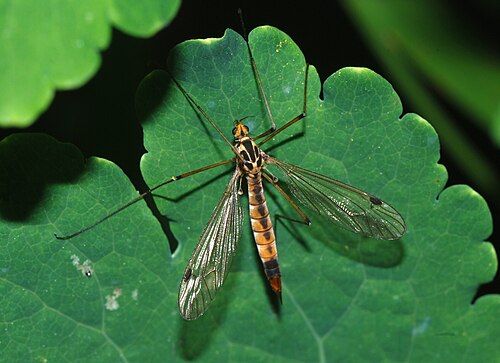
My Crazy Name is: JFC Japanese Crane Fly

The common Japanese crane fly (known locally as Kiriuji gaganbo or scientifically as Tipula aino) is a slender, long-legged insect found abundantly throughout Japan. Though they are frequently mistaken for giant mosquitoes or spiders, these insects are completely harmless to humans. Key Characteristics • Appearance: They have light-brown bodies (14–18 mm in length), a distinct black rim around their wings, and long dangling legs. • The "Daddy Longlegs" Anatomy: Because they are true flies, they possess only one pair of wings. Where hind wings would normally be, they have pin-shaped structures called halteres, which act like gyroscopes to help them balance while flying. Their fragile legs break off easily as a natural defense mechanism. • Habitats: They are highly visible twice a year (from March to June and September to November) near rice fields, farms, and freshwater ponds all over Japan. The Giant of Japan: The Mikado Crane Fly While the standard crane fly is small, Japan is also home to Holorusia mikado (the Mikado crane fly), which is the world's largest mosquito-like insect. • Size: It can reach an impressive wingspan of up to 11 cm (with a body width often stretching around 8 cm). • Behavior: Despite its intimidating, monstrous proportions, it has no stinger, lacks the mouthparts to bite, and cannot feed on blood. It lives a very brief adult life dedicated purely to mating, occasionally drinking nectar or plant fluids.

The common Japanese crane fly (known locally as Kiriuji gaganbo or scientifically as Tipula aino) is a slender, long-legged insect found abundantly throughout Japan. Though they are frequently mistaken for giant mosquitoes or spiders, these insects are completely harmless to humans. [1, 2, 3]

Key Characteristics

  • Appearance: They have light-brown bodies (14–18 mm in length), a distinct black rim around their wings, and long dangling legs. [1]
  • The “Daddy Longlegs” Anatomy: Because they are true flies, they possess only one pair of wings. Where hind wings would normally be, they have pin-shaped structures called halteres, which act like gyroscopes to help them balance while flying. Their fragile legs break off easily as a natural defense mechanism. [1]
  • Habitats: They are highly visible twice a year (from March to June and September to November) near rice fields, farms, and freshwater ponds all over Japan. [1]

The Giant of Japan: The Mikado Crane Fly

While the standard crane fly is small, Japan is also home to Holorusia mikado (the Mikado crane fly), which is the world’s largest mosquito-like insect. [1]

  • Size: It can reach an impressive wingspan of up to 11 cm (with a body width often stretching around 8 cm).
  • Behavior: Despite its intimidating, monstrous proportions, it has no stinger, lacks the mouthparts to bite, and cannot feed on blood. It lives a very brief adult life dedicated purely to mating, occasionally drinking nectar or plant fluids. [1, 2, 3]