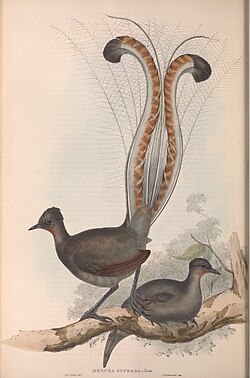
The lyrebird is an ancient genus of ground-dwelling Australian songbirds renowned for their unparalleled ability to mimic natural and mechanical sounds. Belonging to the family Menuridae and genus Menura, they are native to the rainforests and wet woodlands of southeastern Australia. [1, 2, 3]
The Two Species
- Superb Lyrebird (Menura novaehollandiae): The most famous and widely distributed species. Males feature the spectacular, 16-plume tail that fans over the head during courtship displays, taking the distinct shape of an ancient Greek musical instrument called a lyre. [1, 2, 3]
- Albert’s Lyrebird (Menura alberti): A less common and much less showy species restricted to a small area of rainforest on the border of New South Wales and Queensland. [1]
Key Characteristics
| Feature | Description |
|---|---|
| Vocal Mimicry | Equipped with a highly evolved syrinx (vocal organ), they flawlessly replicate other bird species, forest mammals, and human sounds like chainsaws, car alarms, camera shutters, and crying babies. |
| Physical Display | During courtship, males construct small mounds of dirt, clear a stage, and perform an intricate song-and-dance routine, shimmering their ornate tail feathers forward like a canopy over their head. |
| Diet & Foraging | They are ground-dwelling insectivores. Using large, powerful claws, they scratch through leaf litter to dig up earthworms, beetles, spiders, and other invertebrates. |
| Flight Habits | Lyrebirds are predominantly terrestrial and poor fliers. They generally run to escape danger or scale trees by leaping upwards from branch to branch. |
For more specific information, you can read the comprehensive overview on the Wikipedia Lyrebird Entry.