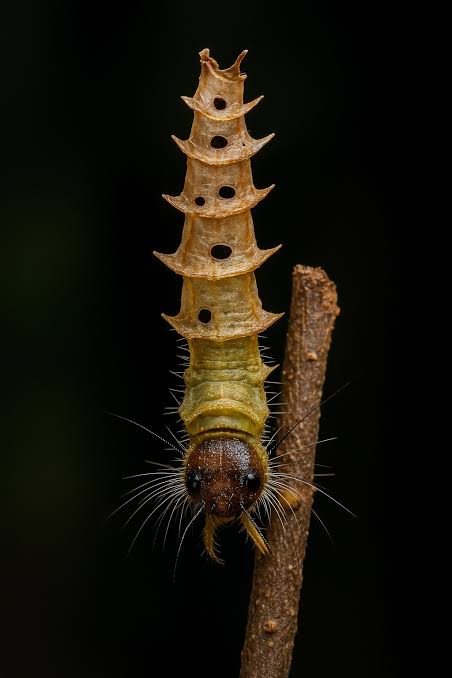
The “mad hatterpillar“ is the popular nickname for Uraba lugens (commonly known as the gum-leaf skeletoniser), a small moth larva native to Australia and New Zealand. It earned its whimsical title because it wears a towering “hat” made out of its own discarded heads. [1, 2, 3]
How the “Hat” is Built
Like all caterpillars, Uraba lugens must regularly molt (shed its exoskeleton) to grow. However, while it discards the rest of its body skin, the empty head capsules from its previous life stages remain stacked precariously on top of its new, larger head. [1, 2, 3]
- The Progression: The caterpillar typically molts up to 13 times. The headpiece begins building around the fourth molt. Because each successive head is larger than the last, the stack tapers upward from largest to smallest, resembling a conical crown or an elaborate fascinator. [1, 2]
The Purpose of the Head Stack
This bizarre millinery is actually a vital evolutionary defense mechanism. Rather than being a useless fashion statement, the stack of old skulls serves two key purposes: [1, 2]
- Weapon and Shield: When threatened by predators like spiders or stink bugs, the caterpillar uses the heavy stack to physically bat attackers away. [1, 2]
- Decoy Target: The empty head shells act as a false target. Predators waste energy and time attacking the hollow, lifeless head capsules instead of the caterpillar’s actual face, buying the insect time to escape. A study found that attacks on larvae with intact head stacks took over 10 times longer than on those with the stacks removed. [1, 2]
Diet and Ecological Impact
The caterpillar is a ferocious eater of eucalyptus leaves. It gets its other common name—the gum-leaf skeletoniser—from its habit of eating the soft tissue of the leaves down to the bare veins, leaving a translucent “skeleton” behind. During high-population cycles, these caterpillars can strip entire stands of trees and are considered a major forestry pest. [1, 2, 3, 4]
The striking appearance of this insect continues to captivate the public and researchers alike, even winning a category in the prestigious Wildlife Photographer of the Year 2025 competition
