
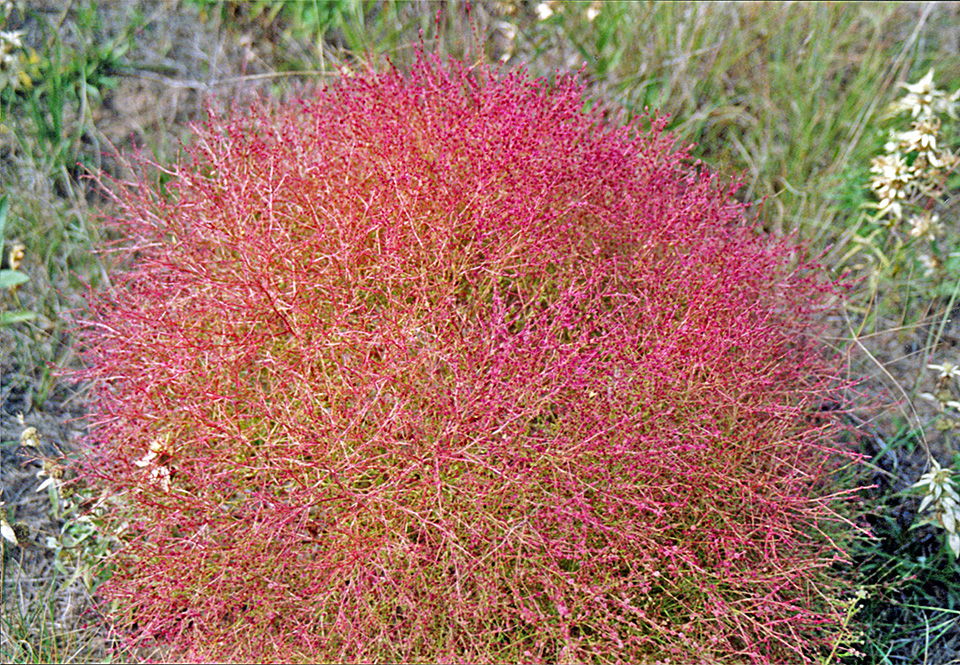
Winged pigweed, scientifically known as Dysphania atriplicifolia (and historically classified as Cycloloma atriplicifolium), is a bushy annual herb native to central North America. Despite its common name, it is highly distinct from standard pigweeds due to its unique horizontal, winged fruits and its late-autumn transformation into a tumbleweed. [1, 2, 3]
🌿 Physical Characteristics
- Growth & Structure: It grows as an intricately branched, pale green, rounded mound reaching between 10 to 60 cm tall.
- Foliage: The plant features alternate, shallowly toothed or scalloped leaves that taper down the stem.
- Flowers & Fruit: It produces small, inconspicuous greenish-yellow flowers from summer into autumn. The defining feature is the fruiting calyx, which develops a distinct circular wing around the seed, facilitating wind and water dispersal.
- Lifecyle: In autumn, the entire plant dries out, snaps at the base, and becomes a tumbleweed to spread its seeds across vast distances. [1, 2, 3, 4, 5, 6]
🗺️ Habitat & Distribution
Winged pigweed thrives primarily in disturbed sandy soils, making it a frequent sight in sandy fields, meadows, beaches, and along roadsides. While native to the central plains of North America, it has steadily expanded. It is now found as an introduced species stretching from California to parts of the Pacific Northwest, New England, and the Canadian prairies. [1, 2, 3, 4]
🌾 Ethnobotanical Uses
Historically, the plant held considerable value for Indigenous peoples. The Hopi and Zuni nations gathered the tiny seeds to use as a grain, often grinding them and mixing them with cornmeal to bake cakes or make mush. Additionally, Zuni healers traditionally chewed the blossoms and rubbed them onto their hands for ceremonial protection. [1, 2]