
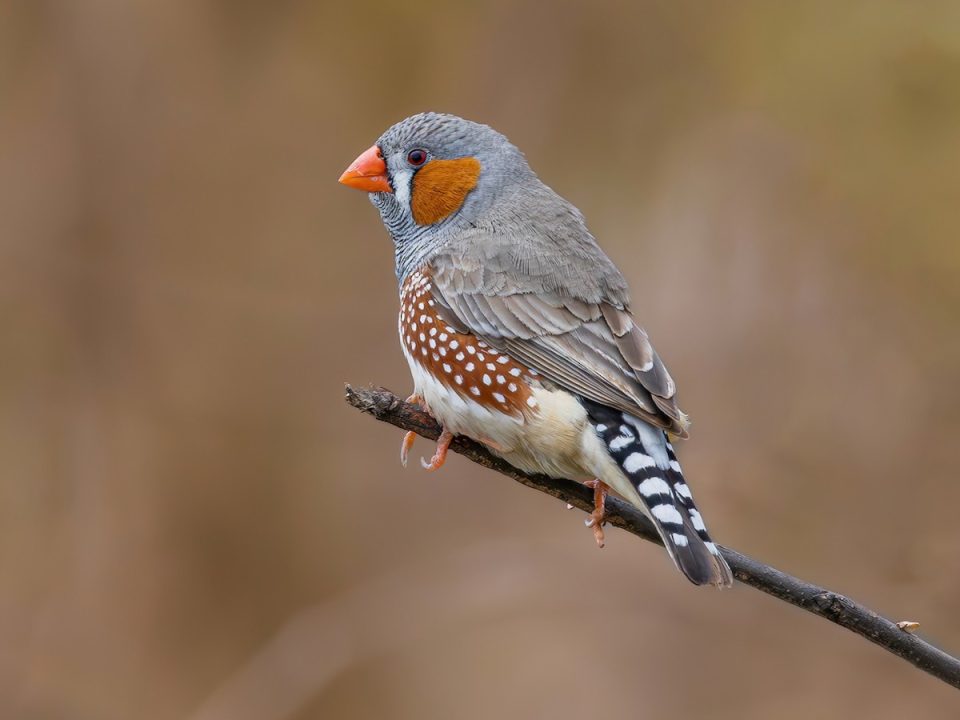
The zebra finch (Taeniopygia guttata) is a small, highly social songbird native to the arid grasslands of Australia and parts of Indonesia. Belonging to the Estrildid finch family, they are widely celebrated for their distinct, striped plumage, energetic personalities, and complex vocal abilities. Because they are hardy and prolific breeders, they have become one of the most popular starter birds for beginner enthusiasts and a crucial model organism for scientific research into vocal learning. [1, 2, 3, 4]
Key Characteristics & Behavior
- Distinct Look: They grow to about 10–11 cm (4 inches) long. “Normal” males feature bright orange cheek patches, a black-and-white striped throat “bib,” and a deep red beak. Females are more muted grey with lighter orange beaks and lack the cheek patches. They both share the characteristic black-and-white barred tail that gives them their name. [1, 2, 3, 4]
- Lifelong Pairs: Zebra finches are strictly monogamous and form intense, lifelong pair bonds. They maintain this connection through constant communication, proximity, and mutual preening. [1, 2]
- Vocal Learners: Males learn complex, unique songs from their fathers and older mentors. Scientists frequently study them at institutions like the University of Oxford or the Max Planck Institute because they develop distinct regional “dialects” much like human language. [1, 2]
- Social Flock Animals: In the wild, they travel in highly mobile nomadic flocks ranging from dozens to hundreds of birds. They prefer hopping and fluttering to long-distance flights, staying close to fresh water and food sources. [1, 2, 3]
Captive Care Essentials
If you are considering keeping zebra finches as pets, their baseline care is highly straightforward:
| Category | Requirement |
|---|---|
| Housing | Must be kept in pairs or small groups to prevent severe loneliness. They require wide flight cages rather than tall cages so they have horizontal space to hop and fly. |
| Diet | High-quality finch seed mixes (millet, canary seed, grass seeds) supplemented daily with leafy fresh greens, vegetables, and occasional fruits. |
| Lifespan | While they only survive 2 to 3 years in the wild, they frequently live 5 to 10 years in captivity under optimal care. |
| Breeding | Highly prolific breeders. If provided a nest box and nesting materials (like grass or coconut fiber), a pair will quickly produce clutches of 4 to 6 eggs. |
You can find comprehensive health guidelines via the RSPCA Zebra Finch Care Guide or review nutritional insights from Lafeber Pet Birds to set up an ideal environment. [1, 2]
Are you researching zebra finches as a potential pet, or are you looking into their wild behaviors and biology? Let me know so I can provide the exact information or cage setup tips you need!